












I’d been circling the shag for about two years before I finally committed. Every time I pulled up reference photos — that gorgeous, lived-in, slightly chaotic fringe, the layers that look like they happened naturally — I’d get cold feet at the salon door and ask for a trim instead. The 70s shaggy haircut has a way of looking effortlessly cool on a mood board and then feeling terrifying in real life. But here’s what I found out after actually doing my research, talking to three different stylists, and sitting in the chair: most of the anxiety comes from not knowing what you’re actually asking for. So let me walk you through all of it before you find yourself guessing.
Where the Shag Actually Comes From
The shag haircut has a creation myth that actually holds up. In 1971, hairstylist Paul McGregor cut it on Jane Fonda for the film Klute, and it became one of those rare Hollywood moments where a haircut genuinely shifted culture. It wasn’t subtle — chunky, choppy layers, a heavy curtain fringe, feathered ends that moved when the camera did. Fonda looked like she’d rolled out of a California canyon and couldn’t care less, which was exactly the point.
What made the shag so radical in the early 70s was that it deliberately broke from the polished, set styles of the 60s. Think Brigitte Bardot’s controlled teased bouffant versus Fonda’s deliberate dishevelment — the shag was a political haircut in the way only a decade like the 1970s could produce. It said: I don’t want to be perfect. It aligned with the broader cultural moment of anti-establishment feeling, women’s liberation, and rock music bleeding into everyday life.
The cut spread fast. By the mid-70s, you had Stevie Nicks wearing a longer, wispier version. Debbie Harry took it punk. David Bowie — yes, he gets referenced here constantly in hair circles — gave it an androgynous glam edge that stylists still cite in consultations today. The shag became a chameleon cut, which is probably why it keeps coming back. It doesn’t belong to one subculture. It’s adaptable enough to absorb whatever the current moment needs it to be.
The 2026 revival is the third or fourth wave depending on how you count. It came back hard in the early 2010s via Alexa Chung’s mod-influenced version, then again around 2020 with a heavier curtain fringe moment. What’s different now is the texture emphasis — modern shags are being cut with much more deliberate razoring and point-cutting to create movement that works with air-drying, not against it. The 70s-inspired layered styles you see everywhere in 2026 are technically more refined than the originals, even if they look wilder.

I find the history part genuinely useful, not just interesting trivia. Knowing that this cut was always meant to look a little undone means you stop fighting it at the styling stage. It’s supposed to have that piece-y, textured quality. That’s the whole idea.
What the Technique Really Involves
This is the part I wish someone had explained to me before my first consultation, because I walked in with a photo and basically said “I want this” without understanding what I was asking a stylist to do. The 70s shaggy haircut is not one technique — it’s a combination of several, and which ones your stylist reaches for depends on your hair texture, density, and the specific version of the shag you’re after.
The structural foundation is layering — but not the gentle graduation you’d get in a classic lob. Shag layers are aggressive. They typically start high, sometimes at the crown, and they’re meant to create visible, distinct weight removal through the mid-lengths and ends. A good shag stylist isn’t blending those layers into invisibility. They’re leaving them defined so the hair falls in sections rather than as one uniform curtain.
Then there’s the fringe. The curtain fringe — parted in the centre, longer at the sides, shorter in the middle — is almost synonymous with the shag at this point, but it’s not mandatory. Some versions use a straight fringe cut just above the brows. Some use no fringe at all and let the face-framing layers do the work instead. The fringe decision matters more than most people realise because it fundamentally changes the maintenance picture (more on that in a moment).
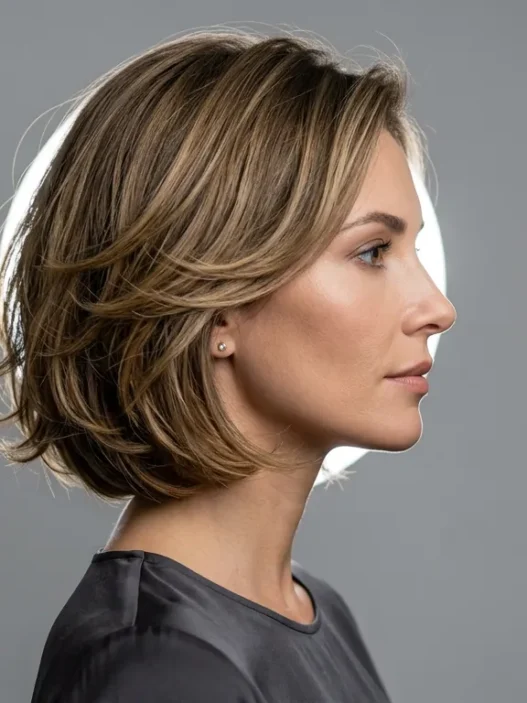
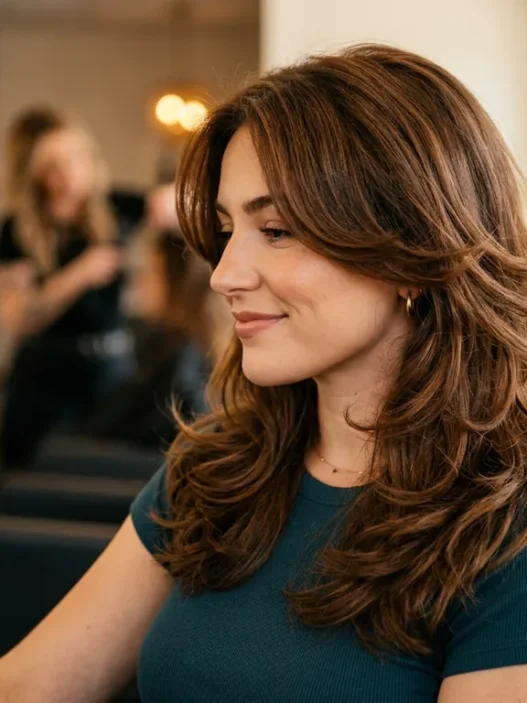
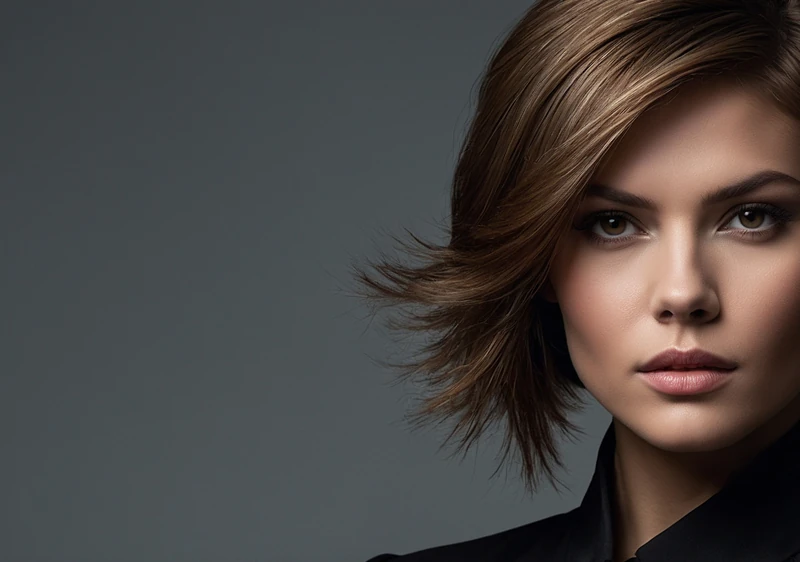
The ends are where the technique gets specific. Traditional razor-cutting creates those feathery, disconnected tips. Point-cutting achieves something similar but with slightly more control. Some stylists combine both. The goal in either case is to remove bulk from the ends rather than adding blunt weight — which is the opposite of what you’d ask for in, say, a sleek straight style. If you have thick hair, this end-thinning is especially important; without it, the shag just becomes a poof. Look at the way her ends fall in the photo here — you can see each layer is deliberately lighter at the tip, not blunt-cut.

For anyone with hairstyles for thick hair already on their radar, the shag is genuinely one of the most effective cuts available — because it removes so much internal weight. The layering strategy essentially does what hours of thinning shears can’t fully achieve. Your hair gets to move like it hasn’t moved since you were twelve.
The consultation conversation you should have: ask your stylist whether they’ll be using a razor or scissors, how high the first layer will sit, and what the perimeter length will be. Those three questions tell you immediately whether they understand what a true shag cut requires versus someone who’ll give you a light layer and call it a day.
A Stylist Breaking Down the Cut Live
Who the Shag Genuinely Flatters (And Who Should Pause)
Here’s my slightly controversial take: I think the shag is more universally flattering than most stylists will admit, and the hesitation around certain face shapes is often overcautious. That said, there are real variables worth understanding before you book.
Oval and long face shapes tend to be cited as the ideal candidates, and yes, the shag is especially good here — the layers add horizontal width and the fringe shortens visual length. But I’d argue square jaw shapes benefit enormously too, because the feathered layers and soft fringe edges round out angular features in a way that very few cuts manage. Look at how the layers frame her jaw in this shot — that’s the thing I kept seeing in reference photos that convinced me the square face concern was overblown.

Round faces are where the conversation gets more nuanced. A shag CAN work on a round face, but the fringe needs to be reconsidered. A full, heavy curtain fringe on a rounder face can compress the face vertically and make it appear wider. The fix is usually a longer, more open curtain fringe — one that parts wider and sits a bit lower — or skipping the fringe entirely and using longer face-framing pieces instead. It’s not a no. It’s a modifier.
Hair texture matters enormously here, maybe more than face shape. The shag was designed for hair that has some natural movement — wavy, lightly textured, or hair that takes a wave well. Straight, fine, slippery hair can absolutely wear a shag, but it requires more styling effort to get the layers to sit with definition rather than collapse. On the other end, very tightly coiled hair creates a completely different but equally beautiful result — the layers add incredible volume and shape.
If you’re already exploring shoulder length hairstyles, the shag is a very natural next conversation to have. The shoulder-length shag is arguably the most versatile length — long enough to show multiple layers of movement, short enough that the layers actually do something rather than disappear. It’s also the length where the curtain fringe is most proportionally balanced.
Who should actually pause? Anyone whose hair is very over-processed, chemically weakened, or extremely fine and fragile. The razor and point-cutting involved in a shag can cause breakage on compromised hair. It’s not forever — give your hair a few months of protein treatments, then revisit. Also: anyone who genuinely doesn’t want to think about styling. The shag rewards a little effort. Not a lot. But some.
How Long This Cut Stays Sharp
Four to six weeks is the honest answer for a curtain fringe. The fringe is the part that grows most visibly, and once it starts creeping past your cheekbones or getting into your eyes, the whole cut loses its proportions. Some people can stretch it to eight weeks if their fringe grows slowly or they’re comfortable with a slightly longer, more swept-back look. I’ve done both, and I personally find the cut looks its absolute best between weeks two and five.
The layers themselves hold their shape longer — realistically eight to ten weeks before they start to feel heavy and the movement gets muffled. This is where people often get disappointed: they love the shag at six weeks post-cut and then slowly watch it transform into something that just looks like mid-length hair with a vague memory of layers. That’s not the cut failing. That’s just growth doing what growth does.

The good news for anyone considering layered medium hairstyles for thick hair: thick hair genuinely holds layered movement longer than fine hair does, because there’s enough density to keep the layers physically separated. Fine hair layers can start to look wispy and slightly shapeless by week six or seven. Thick hair tends to stay defined and bouncy.
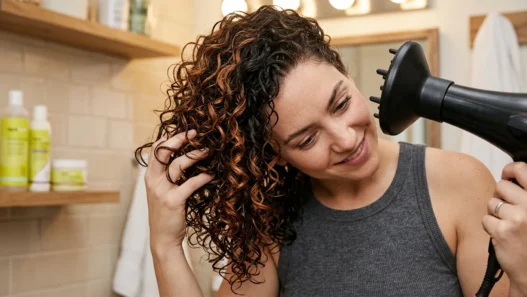
Maintenance between cuts matters a lot with this style. The texture is what makes the shag look intentional rather than just grown-out, so keeping up with a light sea salt spray or texturizing product at home extends the life of the cut significantly. I usually rake a small amount of product through damp hair and then either air-dry or use a diffuser — not a round brush, which tends to smooth out exactly the texture you’re trying to preserve.
One thing I didn’t expect: the shag actually improves in some ways during the grow-out phase if you have natural wave. As the layers loosen and lengthen, the wave pattern gets more room to express itself, and you can end up with something that looks almost intentionally wavy-layered rather than a growing-out haircut. If you’re someone who’s been exploring wavy shoulder length cuts, the shag grow-out can be a surprisingly beautiful transition stage rather than an awkward one.
The Pricing Reality Nobody Posts About
Let me be direct: a proper 70s shaggy haircut takes time. It is not a 20-minute trim. The layering strategy, the fringe work, and the texture detailing at the ends — done correctly — take most skilled stylists between 60 and 90 minutes, sometimes longer on very thick or long hair. That time has to be priced into the appointment.
In major cities, expect to pay somewhere in the range of $95–$180 for the initial cut, depending on the salon’s positioning and the stylist’s experience level. Mid-market salons in smaller cities tend to run $65–$110. Bargain pricing under $50 for a shag should make you nervous — not because cheap salons can’t do good work, but because a shag cut is genuinely more technically demanding than a standard trim or blunt cut, and low-priced appointments are often time-pressured ones.
The return visit cost is where people often get surprised. If you’re trimming the fringe every four to six weeks and doing a full cut refresh every eight to ten, you’re looking at four to six salon visits a year minimum to maintain the look properly. Some salons offer a fringe trim as a complimentary or low-cost service (usually $10–$20), which helps considerably. Ask about this explicitly when you book — it’s a reasonable question and a good one for gauging whether the salon is set up to support a cut like this long-term.

The hidden cost nobody mentions is product. The shag genuinely requires at least one texturizing product to look its best — whether that’s a sea salt spray, a light clay, or a texturizing mousse. Budget around $20–$45 for that product once or twice a year. It’s not expensive, but if you were hoping to air-dry and walk out the door with zero product involvement, manage that expectation now rather than after the cut.
Is it worth it? Financially, yes — because the shag’s lived-in quality means it still looks intentional even as it grows out, which extends the time between full appointments compared to something like a blunt bob that shows roots and shape loss almost immediately. And look, if you’re already investing time reading about layered cuts for thick hair, you’re probably the kind of person who thinks strategically about hair maintenance anyway. The shag rewards that mindset.
Questions I Get About This
Can I ask for a shag if my hair is very straight and fine?
Yes, but manage your expectations around air-drying. Fine, straight hair tends to show each individual layer very clearly, which can be beautiful — but it also means you’ll need a little product or light diffusing to give the layers dimension rather than letting them lie flat. A sea salt spray worked into damp hair is usually enough. Ask your stylist to go lighter on the razor work if your hair is fragile.
Is the curtain fringe part of every shag, or can I skip it?
You can absolutely skip it. A fringe-free shag uses longer face-framing layers to do the softening work instead, and for round or heart-shaped faces, this is often the smarter call. Bring this up clearly in your consultation — some stylists default to the fringe because it’s so associated with the style, so you want to be explicit if you want to go without.
How do I actually style a shag at home without a diffuser?
Air-drying works — it’s actually how the cut was originally intended to be worn. Apply a texturizing product to damp hair, scrunch lightly through the lengths (don’t rake it flat), and let it dry without touching it. The less you manipulate it while it dries, the more natural movement you get. If your hair is very straight and won’t hold a wave, wrap sections loosely around your fingers while wet to encourage some curl before releasing.
Will a shag work if I colour my hair frequently?
Generally yes, but heavily bleached or chemically processed ends may not take kindly to razor cutting, which can cause splitting on weakened hair. If you’re a regular bleach user, discuss this with your stylist before they pick up a razor — scissors-only point-cutting can achieve a very similar result with less stress on the hair. A good conditioning treatment in the weeks before your appointment also helps.
What’s the difference between a 70s shag and a wolf cut?
The wolf cut is essentially a modern descendant of the shag — it borrows the same high layers and curtain fringe but typically sits at a slightly longer length and uses more volume at the crown. The 70s shag is usually more uniform in its layer distribution and leans more into feathered, flat-moving texture rather than the wolf cut’s deliberately full silhouette. They’re cousins, not twins. If a stylist shows you wolf cut references when you ask for a shag, it’s worth clarifying which direction you want to go.

If you’ve made it this far, you probably already know whether the shag is your next move. Go in with the right reference photo (a real photo, not an AI-generated one — stylists have complained to me about this repeatedly), have the technique conversation I outlined, and ask about fringe maintenance pricing upfront. The shag isn’t a low-maintenance cut, but it’s an honest one — what you put in is exactly what you get out. And for a cut that’s been reinventing itself for fifty years, that feels like a pretty good deal.